
Prologue : “In the 12th century, at the close of the third Crusade to free the holy land a Saxon
knight, called Wilfred of Ivanhoe undertook a private crusade of his own.
England’s warrior king Richard the Lion-hearted had disappeared during his
homeward march, vanishing without trace. His disappearance dealt a cruel blow
to his unhappy country already in turmoil from the bitter conflict between
Saxon and Norman. And in time, most of his subjects came to mourn him as dead.
But Ivanhoe’s faith that his king still lived took him on an endless quest from
castle to castle until, at last, he came to Austria…”.

This is prologue of the MGM masterpiece film version
of the 50’s of “Ivanhoe”.
As can be understood, this film is very close to my heart. When I was a
young boy, “Ivanhoe” was one of the few films that impressed me and it still
remains, even after thirty years, one of my favorites and a great entertainment
for all family generations. That’s why I think it is the right choice to accompany
the Christmas period.

This film adaptation glorifies the generous ideals of chivalry of the
High Middle Ages with a message of tolerance between people which, I feel, remains still valid
today, in the same vain as “El Cid” (Anthony Mann / 1962) and “The
War Lord” (Franklin J. Schaffner / 1965). Of course, “The
Adventures of Robin-Hood” (Michael Curtiz / 1937), “The Flame and the Arrow”
(Jacques Tourneur / 1950) and later “Prince Valiant” (Henry Hathaway / 1954) were
popular and still remain. But to me, “Ivanhoe” is more than a very fine entertainment.

Before being made into a movie,
“Ivanhoe” (1819) was one of the most famous novel written by Sir Walter Scott (1771-1832
/ “Rob Roy” (1817) ; “Quentin Durward” (1823) ; “The Tales of The Crusaders”
(1825)…). The huge success of Scott’s novels influenced the 19th century romantic period of literature and inspired many novelists all over
the world, among them, the famous French writer Victor Hugo (1802-1885 / “Marie
Tudor” (1822) ; “Ruy Blas” (1838) ; “Les Misérables” (1862)…). It is still a
matter of inspiration, even today, if we refer to some recent epic movies such
as “Rob Roy” (Michael
Caton-Jones / 1995) and “Kingdom of Heaven” (Ridley Scott / 2005).

The Story
The Third
Crusade is finished. Wilfred of Ivanhoe (Robert Taylor), a Saxon knight, returns
to England and finds out that King of England, Richard the Lionhearted (Norman Wooland), being held for ransom by Leopold of Austria for the enormous
sum of 150,000 marks of silver.

On his way back to his father’s house, he meets two Norman knights Sir Brian De Bois-Guilbert (George Sanders) and Sir Hugh de Bracy (Robert Douglas) with their men and takes them to his father’s castle, who is Cedric the Saxon (Finlay Currie). Here, the young Saxon knight tries to find help in raising the ransom from his father Cedric, a Saxon lord who despises the Norman king Richard the Lionhearted. Cedric refuses to help a “Norman king” and orders his son to leave his home. In the father’s house, Ivanhoe reunites with his love, Lady Rowena (Joan Fontaine), who is Cedric’s ward. The loyal Wamba (Emlyn Williams), Cedric’s court jester, follows Ivanhoe and becomes his squire.

Leaving his
Cedric’s castle, Ivanhoe rescues Isaac of York (Felix Aylmer), a wealthy Jew,
from a band of anti-Semitic bandits. In gratitude, Isaac's beautiful daughter
Rebecca (Elizabeth Taylor) finances Ivanhoe's entry into an upcoming tournament
because he'd planned to use the prize money as a part of the ransom to free the
captured King Richard. At the jousting fields of Ashby-de-la-Zouche, the valiant
Ivanhoe defeats all Norman knights except De Bois-Guilbert, who seriously injures Ivanhoe who is carried off, tended and looked after by Rebecca.

King Richard's
wicked brother, Prince John (Guy Rolfe) plots to discredit Ivanhoe so that the
ransom can never be paid. De Bois-Guilbert Joins Prince John’s conspiracy in
the hope he can get Rebecca’s love. After several thrilling adventures (including the siege
of Torquilstone castle by Robin-Hood’s men), Rebecca is kidnapped and condemned
to be burned at the stake as a witch by a royal judgment.

As a nobleman,
Ivanhoe challenges the verdict on the fields of honor to defend the young girl
against Sir Brian De Bois-Guilbert as royal champion. In the fight to the
death, De Bois-Guilbert loses. Before dying, Sir Brian reaffirms to Rebecca his
love for her. Rebecca accepts that Ivanhoe’s heart has always belonged to Lady Rowena.
King Richard with his knights returns to reclaim his throne from his usurping
brother and to restore the peace in England.
The Beginning of "Ivanhoe" (1952)

The production of a Masterpiece
Several film adaptations were
planned from Scott’s novel. In the mid-thirties, producer Walter Wanger (“Cleopatra”
/Joseph L. Mankiewicz (1963)) planned to film the story with Gary cooper,
Madeleine Carroll and Sylvia Sidney, but nothing came of it. In 1951, the major
part of MGM‘s decision to do the film in England lay in their London Bank
accounts. The studio had piled up fortunes from the British release of their
picture over the years and a portion of it was frozen by government decree. So
the studio had no alternative, but to use the money only in England !

The clever producer Pandro
S. Berman (“A Patch of Blue” /
Guy Green (1965)) bought from RKO an Aneas Mac Kenzie’s film adaptation of the novel,
from which Marguerite Roberts and Noel Langley wrote an excellent screenplay. Bearing
in mind these skills, Berman hired Richard Thorpe who
was known, at the time, as one of the best director of the MGM studios.

Others brilliant
technicians joined the team, among them : “Alfred Junge (as art director),
Roger Furse (as costume designer), Frank Clarke (as film editor),Yakima Canutt
(as second assistant director), Freddie Young (as director of photography) and
Tom Howard (as visual effects photographer)”. Only top artists !

An outstanding Cast
For a while, the English
origin actor, Stewart Granger was considered to portray the noble knight Wilfred
of Ivanhoe. But after the huge success of the monumental epic movie “Quo Vadis”
(Mervyn LeRoy / 1951), the versatile American Robert Taylor was considered the most appropriated
choice. Then, MGM gave to Granger the title role in the vivid “Scaramouche”
(George Sidney /1952)...turning out to be very wise choices for both movies.

Robert Taylor
Dame Elizabeth Taylor hesitated
to take the role of Rebecca offered by MGM. Then, the studio announced that
Deborah Kerr would replace her while Margaret Leighton would likely portray
Lady Rowena. But eventually, the young actress accepted the part and Joan
Fontaine portrayed Lady Rowena.

Robert Taylor & Elizabeth Taylor
A host of talented British
performers were also in the cast : “George Sanders (as Sir Brian De Bois-Guilbert), Finlay Curie (as Cedric the
Saxon), Felix Aylmer (as
Isaac of York), Emlyn Williams (as Cedric’s court jester), Guy Rolfe (as Prince
John), Robert Douglas (as Sir Hugh de Bracy), Harold Warrender (as Locksley /
Robin-Hood) and Norman Wooland (as Richard the Lionheart)…”.

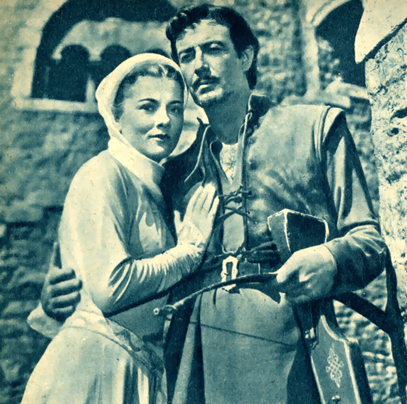
Robert Taylor & Joan Fontaine

The shooting of “Ivanhoe”
In July 1951, the shooting began in England at the
Boreham Wood Studios (outside of London) and in Italy (Sprechenstein) for some
exteriors. It ended in September of the same year.
To recreate the High Middle Ages, the efforts of the production team were outstanding.
Two years before the shooting, the Torquilstone Castle
as a full-scale replica of a twelfth-century fortress, was built. The moat was
cut around the set and the castle was twenty feet wide and ten feet deep !

The recreation of the jousting fields of Ashby-de-la
Zouche, was the second big challenge. It was brightly decorated with stands,
pavilions, knightly tents and costumed horses.
The movie called for the making of an armory of
medieval weapons and costumes (arrows, swords, suits of chain-mail, shields,
saddles, crossbows and maces) and required sometimes from five hundred to a
thousand of extras.
But above all, the Movie required an enormous “military
organization” with one hundred of suitably horses and the
collaboration of a professional stunt team, with the great Yakima Canutt (“Ben-Hur”
/ William Wyler (1959)).

A gathering of incredible talents
The American actor Robert Taylor gave a very
convincing performance in the part of the Saxon Knight Wilfred of Ivanhoe. After
“Quo Vadis” (1950), “Ivanhoe” got Taylor off to a whole new career as a
medieval hero. Richard Thorpe would use him again, with a very great sense of
good taste, his looks and bearing in “The Knights of the Round Table" (1954) and
“Quentin Durward” (1955) all produced by Pandro S. Berman with MGM.

George Sanders, Elizabeth Taylor and Robert Taylor on the set.
After “A place in the Sun” (George Stevens / 1951),
the young and gorgeous Elizabeth Taylor gave for the second time a proof
of her great talent in the major dramatic role of the Jewish maiden Rebecca.

Robert Taylor and Joan Fontaine on the set.
The high class actress Joan Fontaine (“Letter from an
Unknown Woman” (Max Ophüls / 1948) ; (“Othello” (Orson Welles / 1952)…) played the prim and proper Lady
Rowena. In face of Elizabeth Taylor, the beautiful actress gave an elegant
performance as Ivanhoe's bride.

George Sanders (“Samson and
Delilah” (Cecil B. DeMille / 1949) ; “All about Eve” (Joseph L. Mankiewicz /
1950) ; “The Kremlin Letter” (John Huston / 1970)) gave, like always, an outstanding
performance. Sir Brian de Bois-Guilbert, a Templar warrior, was the most complex
and interesting role in the film. The death scene of his character is a very
powerful and emotional moment. Here, Sanders gave to his part an extraordinary
Shakespearean dimension.

George Sanders as Sir Brian De Bois-Guilbert
All the rest of the cast is just perfect. The Scottish
origin actor Finlay Currie (“49th Parallel” (Michael Powell and Emeric
Pressburger / 1941), “Quo Vadis” (Mervyn Le Roy /1951)…), who will be a great
Balthazar in “Ben-Hur” (1959), played Cedric
the Saxon, Ivanhoe’s father with a strong and great ability. In the same way,
the English actor Felix Aylmer (“Quo Vadis” (Mervyn Le Roy /1951), “Exodus”
(Otto Preminger /1960), “Becket” (Peter Glenville / 1964)…) played a wise Isaac
of York and beloved Rebecca’s father.
The Welsh origin actor, Emlyn Williams gave also a
very good performance as the loyal Wamba, the Cedric’s court jester.
Guy Rolfe (as Prince John) and
Robert Douglas (as Sanders's sidekick Sir Hugh de Bracy) confirmed that they were
born to play bad guys for our great pleasure.

Robert Taylor and Robert Douglas
In the early 50’s, “Ivanhoe” was one of the few movies
shoot in color with the contribution of the Technicolor laboratory. The work of
the legendary cinematographer Freddie Young (“Lawrence of Arabia” (David Lean /
1962), “The Mission” (Roland Joffe / 1986)) was prodigious. Never before had the
photography of an adventure medieval film been so beautiful and well used especially for the action scenes, except perhaps, the outstanding work of Tony Gaudio
and Sol Polito, the cinematographers of “The Adventures of Robin-Hood” (1937). The results of this MGM’s
masterpiece extended the technical limits of the photography in the industry of
the period and beyond. With the other legendary British cinematographer Jack
Cardiff, Freddie Young proved that he was one of the greatest professional of
his time. A great step was passed.

Miklós Rózsa : “working on Ivanhoe”
When MGM asked Miklós Rózsa
to compose the score of “Ivanhoe”, he was already known like a very versatile
composer in Hollywood. He was hired by the MGM studios in 1949 and signed
important scores among them two classic movies : “Madame Bovary” (Vincente
Minnelli / 1949) and “The Asphalt Jungle” (John Huston /1950).
“Ivanhoe” was the 11th music score between “Quo Vadis” (1950) and “Plymouth Adventure” (1952) that he
composed for the American studio. The MGM years (1949 – 1968) were probably the
second most prolific period of the film composer’s career, of which the peak was the
masterpiece epic movie “Ben-Hur” (1959) winning his 3rd Academy Award
for “Best Music Score” !

In his biography “Double
Life”, the Hungarian origin composer remembers how happy he was to work on this
movie. In 1977, he agreed to give an interview to the French branch of The Max Steiner Film Society after the
new recording session of “Quo Vadis” in London (see the link underside of my
other blog). The composer explained the way he worked on this movie :
Quote.
Beside « BEN-HUR », « QUO VADIS »,
and« EL CID », what were the other epic movies that you liked to
compose ? « IVANHOE » for instance ?
This movie was shot in London and the music was
written in Hollywood. I took a great pleasure in working on that movie because
I read the novel when I was young in Hungary and liked Sir Walter Scott’s
novel. Mr Richard Thorpe directed it but I never discussed about the music or
anything else with him. He only said to me « Hello, How are
you ? ». The movie was put in my hands and the MGM executives said to
me : “well, please go ahead. Do what you want… ” ». I liked this way of
working very much because I needed nobody to tell me what to do and how to do
it. This project interested me because it was so close to my heart.
Unquote.
Main Title (Original Score / 1952)

The Composer Miklós Rózsa
Rebecca's Love Theme (Original Score / 1952)
In his book, “The Great Adventure Films” (1976), the film music historian and close friend to the composer, Tony Thomas praised the work of Rózsa and the colossal efforts of the MGM studios to make the movie a masterpiece of the adventure medieval film.

To Rózsa fans, the music of “Ivanhoe” remains one of the greatest score of his American period, just after the talented British productions of Alexander Korda for the London Films studios (“Knight without Armor” (1937), “The Four Feathers” (1939), “The Thief of Bagdad” (1940), “That Hamilton Woman “ (1941) and “The Jungle Book” (1942)…).
Everyone who like the score
will agree with me that without Miklós Rózsa’s music, the film could have lost 50
% of his attraction and I can’t imagine another music in place of it !
Short Suite from "Ivanhoe"
A great Score on CDs
For a long time, only
a short suite from the original score was available on a LP–combined with
selections from “Madame Bovary” and “The Plymouth Adventure”. Then, in 1994,
the Intrada Label produced a CD in his Excalibur Collection, of a new recording
of the complete score. Douglas Fake was co-producer, Tony Thomas was the
project coordinator with Kathleen Mayne and Daniel Robbins (Orchestral
reconstruction). The Sinfonia of London was conducted by Bruce Broughton. A
great recording !
Fifty years after the first
world release of the movie, Rhino Label with Turner Entertainment produced a
new album CD (2002) including most of the cues from the 1952 original score. In
2009, Lukas Kendall completed this issue with his Private Label FSM in producing
a 15 CDs Box (“Miklós Rózsa Treasuary”) with the missing tracks from MGM original studio tapes.
I want to conclude this
tribute to the composer, with a statement from the LP Album “The Spectacular
Film World of Miklós Rózsa - Edition one” (1985) written by another friend of the
great artist and film music historian, Christopher Palmer (orchestrator /
Assistant of Elmer Bernstein and Maurice Jarre).
Quote.
“Listening
to the music of Miklós Rózsa affords a rare satisfaction – more, a sense of
exhilaration : “That of the listening to music which is supremely well
composed. Not all composers, particularity in the sphere of film music, compose
well, or even competently, but Rózsa is one of them. … For him, music is a
glorious human language - above all human – forever growing yet never growing
old. Rózsa has mastered it exceptionally…””.
Unquote.

“Ivanhoe” on the screen
The premiere of the movie took place in the summer of
1952 at the Radio City Music Hall, New York. It became quickly a smash hit ($1,310,590
at the box office, in his opening of 39 days !). “Ivanhoe” took more than $6
million, making it MGM's biggest earner for 1952 and one of the top four
money-makers (ahead of “Singing in the Rain” (Stanley Donen)).
The Film was nominated for three Academy Awards (“Best
Picture, Best cinematography, color and Best Music Scoring) and for the Golden
Globe Award (Best Film Promoting International Understanding and Best Motion
Picture Score). In addition, Richard Thorpe was nominated by the Director’s
Guild of America, USA for Outstanding Directorial Achievement in Motion
Pictures and Miklós Rózsa lost the
Oscar against Dimitri Tiomkin’s “High Noon” (Fred Zinnemann / 1952). Bad luck !

Nevertheless, the responses of the audience and the
critics all over the world were very positive. Today, this film adaptation of
the Sir Walter Scott classic remains one of MGM's most solid adventure movies of
the 50”s with “King’s Solomon’s Mines” (Compton Bennett / 1950), “Scaramouche”
(George Sidney / 1952), “The Prisoner of Zenda” (Richard Thorpe / 1952),
“Valley of the Kings” (Robert Pirosh / 1954) and “Moonfleet” (Fritz Lang /
1955). Many regard the movie as a classic…
In England (and in Europe, also), “Ivanhoe” became a very
popular film. Because of this great success and for the same financial reasons as
the Metro, Walt Disney studios decided to produce in England, three fine movies
with the talented British actor Richard Todd : “The Story of Robin Hood and His
Merry Men” (Ken Annakin / 1952), “The Sword and the Rose" (Ken Annakin / 1953)
and “Rob Roy, The Highland Rogue” (Harold French /1954)”…
For the record, it can be remembered that in the subsequent
years, several movies from Scott’s Ivanhoe were also produced (I forget the TV
series with Roger Moore in his youth). As far as I can know, these movies were
never shown outside England, although James Mason played Isaac in one of them.

A message of hope to all children in the world
The first time I saw the Metro’s 1952 “Ivanhoe”, I was nine years old. I have never forgotten this wonderful moment. To me, it is the perfect movie
which can awake the noblest feelings in the heart of mankind : “loyalty, love, faith
and friendship”.
“Ivanhoe” contains all the
ingredients for a very good adventure film (magnificent fights, beautiful
costumes and impressive sets) together with strong and intelligent message of
tolerance. That’s why it
is a great epic but at the same time, an uncommon romantic entertainment.
Although, the Metro adaptation is quite different from
Scott’s novel, I think that the movie is more romantic than the original story.
The conflicts between each main character are more realistic and especially the
loving rivalry between George Sanders (as Sir Brian) and Robert Taylor (as Sir
Wilfred) for the Elizabeth Taylor - Rebecca’s love. I hope that many will share the same pleasure in
watching the movie again and again….
The Trailer
I dedicated this review to children all over the world
and especially to those who have not the luck to live in a loving and peaceful country.
Merry Christmas to all.

P. S. : If you want to know more about “Ivanhoe”,
please refer to :
● Books
:
a) The Novel
“Ivanhoe” by Sir Walter Scott (in
English), Empire Books, 2011, USA.
“Ivanhoe” by Sir Walter Scott (in
English), Penguin Classics (Paperback) New Edition, 2000, UK.
“Ivanhoe” by Sir Walter Scott (in French,
translation by G. De La Ruwiere), Ref. G 10, Marabout Géant, Des Presses de Gérard
& Cie, Belgium.
“Ivanhoe”
by Sir Walter Scott (in French), Livre de Poche Jeunesse, 2009, France.

b) The Movie and Actors
“The Films of Robert Taylor” by Lawrence
J. Quirk (in English), 1975, Citadel Press Book, USA.
“The Films of Eizabeth Taylor” by Jerry
Vermilye and Mark Ricci (in English), 1976, Citadel Press Book, USA.
“Elizabeth Taylor” by Patrick Brion (in
French), 2010, Riveneuve Collection Cinéma, France.
Autobiography of George Sanders, “Memoires
of a Professional Cad” (in English), 1992, Scarecrow press, Lanham, Maryland, (Foreword
by Tony Thomas), USA.
Autobiography of George Sanders, “Mémoire
d’une Fripouille” (in French, Translation by Romain Slocombe), 2004, Presse Universitaire
de France (Foreword by Tony Thomas), Paris, France.
“The Great Adventure Films” by Tony Thomas
(in English), 1976, Citadel
Press Book, USA.
“Le Film d’Aventure” by Patrick
Brion (in French), 1995, Edition de la Martinière, Paris, France.

c) The Music Score of Miklós Rózsa
“Double Life” by Miklós Rózsa (in English), 1982, Hippocrene Books Inc,
New York, USA.
“Rózsa” by Christopher Palmer (in English), 1975,
Breitkopf & Härtel, Wiesbaden, GB.
“Spellbound, The Miklós Rózsa Music Society”, Newsletter S1, July 1978, Australia.
“Spellbound, The Miklós Rózsa Music Society”, Newsletter S2, October 1978,
Australia.
“Music for the Movies” by Tony Thomas (in English),
1973, Barnes Tantivy, USA.
“Film Score : The
Art & Craft of the Movie Music” by Tony Thomas (in English), 1991,
Riverwood Press, USA.

● Video
:
“Ivanhoe” by Richard Thorpe, 1952 / 2005, Warner Home Video, US DVD All Zone,
Ref.N° B0006B2A6U, Full Screen Edition, NTSC, 1.33.1. Languages : English
English (Dolby Digital 1.0 Mono) and French (Dolby Digital 1.0 Mono), English,
French and Spanish Subtitles.
(Special Features : “Oscar-winning Tom
and Jerry cartoon "The Two Mouseketeers" and Swashbuckler movie
trailer gallery (“Ivanhoe”, “Scaramouche” and “The Knights of the Round Table”)).
“Ivanhoe” by Richard Thorpe, 1952 / 2007, Warner Home Video, French DVD
Zone 2, Ref. N° 6515400, Full Screen Edition, Pal, 1.33.1. Languages : English
English (Dolby Digital 1.0 Mono) and French (Dolby Digital 1.0 Mono), French Subtitles.

● Music :
a) LP Albums
LP Album of “Ivanhoe” and “Plymouth Adventure”, 1952,
MGM E179 10, Monophonic Sound, USA.
LP Album, Music recorded directly from the sound tracks
of the MGM Motion Pictures, “Ivanhoe”, “Madame Bovary” and “Plymouth Adventure”,
1957, MGM Records, MI 1394 and (SU 1021), USA.
LP Album of “Ivanhoe”, “Madame Bovary” and “Plymouth
Adventure”, 1975, Silver Screen Soundtrack Series, MGM 2353 - 095, England.

b) CD Albums
Original Score
CD Album of “Ivanhoe” by Miklós Rózsa (Original Score of 1952), 2002, Rhino RHM 2 7772, USA.
CD Box of 15
discs “Miklós Rózsa Treasuary (1949-1968)”, (CD N°13 contains the missing
tracks of the Original Score of 1952, 2009, FSM Box N°4, USA.

Rerecording Score
CD Album of the Rerecording of the complete Score of “Ivanhoe” by Miklós Rózsa, Bruce
Brughton conducted the Sinfonia of London, Intrada / The Excalibur Collection,
1994, MAF 7055D, USA.( http://store.intrada.com/s.nl/it.A/id.797/.f).
CD Album of “Spellbound
: Classic Films Score of Miklós Rózsa”, RCA Red Seal / Sony Music
Entertainment, 2011, Ref. 88697 81269 2, New York, USA.
Charles Gerhardt conducted the Overture of “Ivanhoe” with the National
Philharmonic Orchestra. This album contains Symphonic suites from “The Red House”, “The Thief of Bagdad”, “The Lost Weekend”, “The Four Feathers”, “Double
Indemnity”, “The Jungle Book” and “Spellbound”.

● Websites :
a) Sir Walter Scott
b) Sir Walter Scott / “Ivanhoe” The Novel
c) The Movie (1952)
The Movie (French link)
d) Dame Elizabeth Taylor
e) Joan Fontaine
f) Robert Taylor
g) George Sanders
h) Miklós Rózsa
Miklós Rózsa Society
Website (Official
Website)
Miklós Rózsa at the Recording
of "Quo Vadis" (1977)

Here are some stills from my collection :




De Bois-Guilbert : "But you were always mine and only mine. God keep you".

Rebecca : “Milady, in death he spoke the truth".
Lady Rowena : “You still love Ivanhoe ?” .
Rebecca : “No, Milady. I stole a little happiness,
perhaps but not from him or you only from my dreams. His heart was always
yours".

King Richard : “Before me knells a notion divided. Rise as one man, and that one for England !".

Long Live England ! Long Live England !

NB : My thanks to Mr Alan Hamer, the European Representative of the Miklós Rózsa Society for his friendly contribution.


